William Alexander
Quantz
– Biography Background Information
(Editor’s Note: This
biography background is a brief summary with some pictures to go with his
Memorandum. It is an ongoing project and will be updated periodically.)
WILLIAM ALEXANDER QUANTZ was born
26 Nov 1854 in Markham, Ontario, Canada, and died 18 Jun 1945. He married (1) SUSAN REMINA CLAYTON 05 Oct
1881. She was born Sep 1854, and died 03
Apr 1892 in Toronto, Ontario. He married
(2) FLORENCE ELLA AMOS 13 Apr 1898. She
was born 15 Aug 1869, and died 10 Jan 1959.
Children of WILLIAM
QUANTZ and SUSAN CLAYTON are:
i. EDNA JANE9 QUANTZ, b. 05 Jul 1882; d. 22 Aug 1960; m.
WILLIAM R. REID, 20 Apr 1910.
ii. CLAYTON
QUANTZ, b. 08 Jul 1886.
iii. FLORENCE REMINA QUANTZ, b. 24 Mar 1892; d. 02 May 1892,
Toronto, Ontario.
Children of WILLIAM
QUANTZ and FLORENCE AMOS are:
iv. GORDON AMOS9 QUANTZ, b. 16
Mar 1901; d. 13 Oct 1967; m. (1) KATHLEEN HARRISON, 13 Jan 1945; m. (2) AUDREY
LUELLA EMERY, 07 May 1958.
v. JOHN OSCAR QUANTZ, b. 10 Jun 1903; m. EILEEN
GERTRUDE TAYLOR, 10 Jun 1949.
Moved
to Hard Scrabble Farm, near Ballantrae, and farmed there for several years. It was very
hard work clearing part of the bush and turning it into fields for gains and
grazing. Eventually the farming proved unsustainable for William so in November
1890 – he sold off his equipment and livestock, leased the farm out to Philip
Badgero for a term of four years and moved to Toronto on Saturday, Jan. 3,
1891. Initially they stayed at his father-in-law’s, Father Clayton, but then
moved into a rental place of their own.
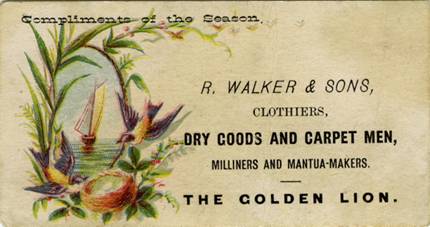 In
February of 1893 William started working for Walker and Sons of The Golden
Lion. They were a dry goods company that employed several delivery men who
delivered their goods by wagon all across the city. The work days were very long but it helped
take his mind off the deaths of his wife and daughter.
In
February of 1893 William started working for Walker and Sons of The Golden
Lion. They were a dry goods company that employed several delivery men who
delivered their goods by wagon all across the city. The work days were very long but it helped
take his mind off the deaths of his wife and daughter.
A card for the customers

They were located at
33 to 37 King Street (King and Colburne Streets) in Toronto.
Pictures are from the
Toronto Public Library’s Virtual Library. See http://static.torontopubliclibrary.ca/da/pdfs/ndtradecardsg-goldenlion.pdf
Epworth
Church
Epworth Church,
situated on the corner of Yarmouth and Christie Ste., in Toronto, was
erected in 1890, owing to the strenuous exertions of the Rev. Jonathan Milner.
It was a plain frame, rough-cast building, seating comfortably 250 people, and
was at first what would be in Anglican parlance a "chapel of ease" to Bathurst St. Church.
See: The Methodist Churches of Toronto: a history of the Methodist Denomination ... By Thomas Edward Champion
Epworth Methodist Church,
Christie Street at Yarmouth Road, 1890 (telegram [Toronto], 2 August 1890, 6
t.c.) designed by GORDON &
HELLIWELL. See http://dictionaryofarchitectsincanada.org/architects/view/1592
Broadway Tabernacle
Broadway Methodist Tabernacle
was a prominent Methodist church in Toronto, Canada, that existed from 1872
to 1924. The congregation was originally housed in a wood chapel at the
intersection of Spadina Avenue and Dundas Street, which at that time was known as St. Patrick St. It was
originally named the Spadina Avenue Methodist Church. Rapid growth in the
congregation saw it seek a new home, and in 1876 a larger lot was purchased at
the northeast corner of Spadina and College Street. The wooden church was transported on rollers north to the new
location. The old site eventually became the location of the Standard Theatre.
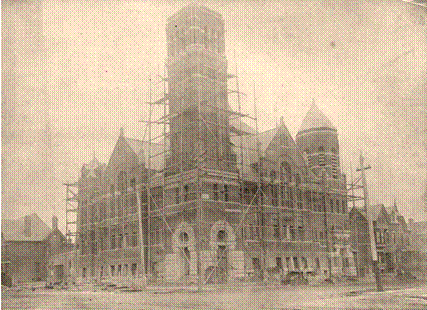
Broadway
Tabernacle
Construction 1889
In 1879 work began on a new brick church that would be able to
seat 900. The church was also renamed Broadway Methodist Church, as at that
time the wide stretch of Spadina from College to Bloor was often known as
'Broadway.' That church also became too small, and in 1887 it was almost
completely demolished and replaced by a third structure. This building was
designed by E.J. Lennox, the most prominent architect then practicing in Toronto. At the
request of the congregation he copied the basic floor plan and design of his
earlier Bond Street Congregational Church, but at a larger scale. Rather than employing the neo-Gothic style, as he
had with Bond Street, Lennox designed the church in the Romanesque Revival style. The building thus had many similarities in style of the City Hall that Lennox was working on simultaneously.
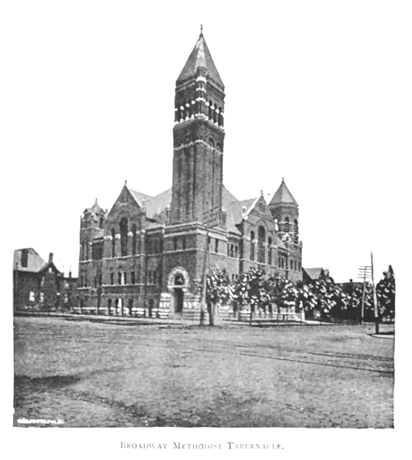 The new Tabernacle opened in 1899 and became one of the major
centres in the city that was sometimes dubbed the Methodist Rome.
Near to the large working class population of west Toronto and the textile
mills of Spadina it became an important social centre. This was especially true
under the leadership of Dr. Salem Bland, one of the leading Social Gospel
advocates in Canada, and who led the church from 1919 to 1923.
The new Tabernacle opened in 1899 and became one of the major
centres in the city that was sometimes dubbed the Methodist Rome.
Near to the large working class population of west Toronto and the textile
mills of Spadina it became an important social centre. This was especially true
under the leadership of Dr. Salem Bland, one of the leading Social Gospel
advocates in Canada, and who led the church from 1919 to 1923.
However, the nature of the
neighbourhood was changing. New immigrants from Southern and Eastern Europe,
most notably a large Jewish population, were moving into the working class area
and the Methodist English were moving north to other neighbourhoods.
The merger of churches that created the United Church of Canada in 1924 led to the eventual closing of the Tabernacle. The
building was demolished by 1930, and replaced by the four storey office
building that stands on the site today.
See http://en.wikipedia.org/wiki/Broadway_Methodist_Tabernacle - 1872 to 1924
1895 Fires
There were three major fires in Toronto in early 1895. William Quantz
writes of them on page 292.
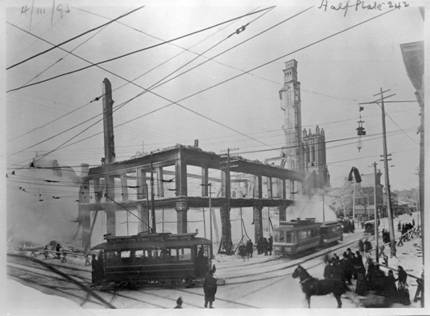
SW corner of Queen and Yonge. The
Simpson building was completely destroyed.
The damaged spire of Knox Church can be seen at rear. Photo taken March
4, 1895
See pictures and information at http://goadstoronto.blogspot.com/2012/10/the-great-toronto-fires-of-1904-and-1895.html
W.A Murray & Sons
William worked for Murray & Sons as delivery-man, maintenance worker
and night-watchman.
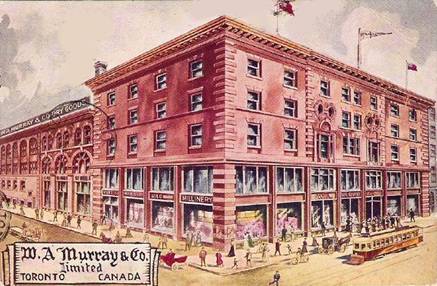
Postcard of the W.A. Murray & Co dry goods
store, 17-27 King Street East, Toronto, Canada. Source is
John Chuckman Collection - Vintage Toronto Postcards, Date 1909 (Permission –
Public Domain)
Jacob “Jake” Daniel Quantz
Jacob
Daniel Quantz was William’s brother. Mid-way through 1895 he moved back from
Kentucky and prepared to move to Alberta. William’s entries are;
Volume 3, Page 295
August 3:. I
am feeling better and working quietly along. Work is not pressing now and the
weather fine for driving. Friday night I went to Northcote Avenue to see
Brother Jake and family. They have just come from Kentucky and are going on to
Flos today.
Volume 3, Page 297
September 21:.
A rather eventful week. Brother Jake was with us till
Tuesday morning when he started on his journey to Alberta, N.W.T. (North West
Territories).
Roads
With
the assistance of Lorne Smith and Ruth Burkholder
While
living on the farm (both periods) William makes regular reference to the roads whether
for travel or with respect to maintenance or being blocked after a snow storm.
Owners had responsibility initially
for clearing the road allowance in front of their property. In the 1800's each
owner had to give an allotted time for mandated road maintenance. Snow
clearance was another matter. It was a community affair--more like a community
bee, not mandated. It was a necessary community effort if anyone was to get
anywhere.... and those with 'equipment' ... horse and grader or blade .... would be the ones who
would get out and clear a path ... shovels also helped.
Moving Back to Hard Scrabble Farm
Volume 4, Page 380, October 20
They
moved from Toronto back to Hard Scrabble Farm. The old house was no longer
suitable. They had to move the old house back from its original position to
allow for construction of a new house. They lived in the old house while
William constructed the new house. It took time and William had to work the
farm at the same time as building the house.
Hard
Scrabble Farm was located at Lot 26, Concession 9 of Whitchurch (northeast
corner of 9th Concession and St. John Side road – one concession
north of Church Hill). It is still an operating farm today but the western part
is returning to bush with trees and underbrush.
The
following map shows the various fields William refers to in his 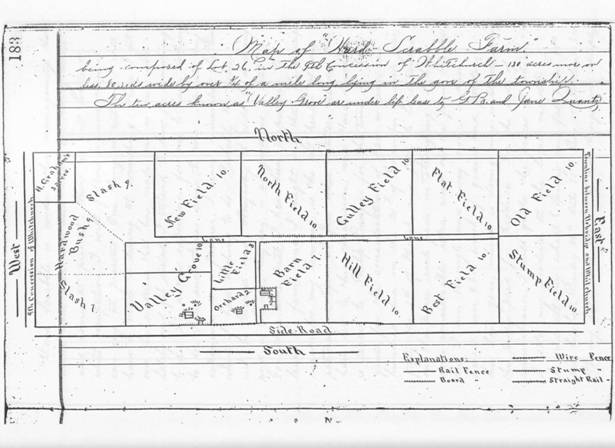 memorandum.
Note too that Valley grove is just to the west of the Hard Scrabble house and
barn.
memorandum.
Note too that Valley grove is just to the west of the Hard Scrabble house and
barn.
Lazenby’s moved into a new house in early July
1901. They were still nearby but where did they move to?
Volume 4, Page 400, Aug. 30
William Paisley helping with farm chores and harvest.
Volume 5, Page 35, August 10
Threshing
Threshing
the grain crops in the late summer and fall was often also a community effort.
The operator, who owned the equipment, would be hired by each farmer while the
operator was in the neighbourhood. The farmers would help each other to provide
the manpower to efficiently harvest the crop and bring it to the barn to run
through the threshing machine.
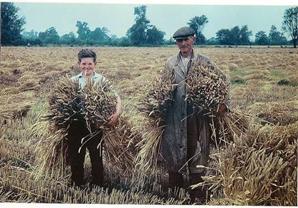
 Shocking
of the Rye
Shocking
of the Rye
This
applies to wheat and oats as well. “Shocking”
is also known as “Stooking” in some
areas. Those of us born in the age of combines harvesting grain crops we are
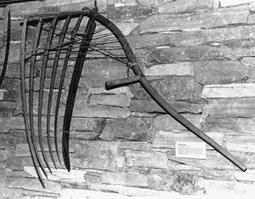
not used to the terms used in the harvesting process in William’s day. Usually
William had to cut the grain crop using a Cradle
that had a scythe blade to cut the stalks and then the cradle portion caught
the cut stalk.
See: http://www.americanartifacts.com/smma/grain/cradle.htm
 The
website ehow.com describes the process this way; In earlier
times, farmers cut grass and grain by hand using long hooked knives, or
scythes. Once cut, the stalks were bundled and bound into sheaves; then the
sheaves were bundled together upright to dry. These larger bundles, made up of
sheaves, were called "shocks." A shock of summer wheat consisted of
12 sheaves; a shock of winter wheat or rye contained 18 sheaves. When dry, the
sheaves could be threshed. The seed was collected for food, and the remaining
straw, or chaff, was used to feed livestock.
The
website ehow.com describes the process this way; In earlier
times, farmers cut grass and grain by hand using long hooked knives, or
scythes. Once cut, the stalks were bundled and bound into sheaves; then the
sheaves were bundled together upright to dry. These larger bundles, made up of
sheaves, were called "shocks." A shock of summer wheat consisted of
12 sheaves; a shock of winter wheat or rye contained 18 sheaves. When dry, the
sheaves could be threshed. The seed was collected for food, and the remaining
straw, or chaff, was used to feed livestock.
See: http://www.ehow.com/about_5306045_sheaves-grain.html
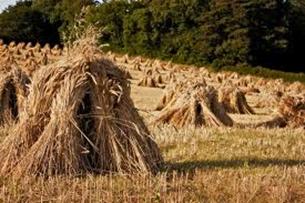
Shocks
or Stooks of grain
See:
http://commons.wikimedia.org/wiki/File:Stooks_of_barley_in_West_Somerset.jpg

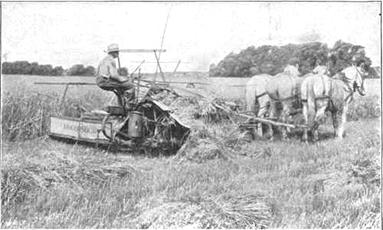 As time
progressed binders were used to cut and bind the bundle of stems into sheaves
using “binder twine” string. The binder then laid the sheaf on the ground. This
speeded up the process but the farmers still needed to gather the sheaves
together, by hand or using their pitch-forks, into shocks or stooks depending
on your local community.
As time
progressed binders were used to cut and bind the bundle of stems into sheaves
using “binder twine” string. The binder then laid the sheaf on the ground. This
speeded up the process but the farmers still needed to gather the sheaves
together, by hand or using their pitch-forks, into shocks or stooks depending
on your local community.
House in Stouffville
Volume 5, Page 100, Nov. 3, 1917
William
and Flo decided to leave the farm and move into Stouffville. On page 100
William and Flo sold their farm, Valley Grove, to Mrs. Pace for $3,700.00. They
started their search for a house in Stouffville and had verbally committed to
one but just before Christmas 1917 that purchase fell through.
On
Volume 5, Page 104, Jan. 19, 1918, they purchased a property with an old house
on the south side of Main Street two houses west of the railroad tracks. They
paid over of $1,500.00 for a house purchased from Mrs. Williamson. It consisted
of a lot of old rambling buildings which had to be taken down and remodeled.
 On Volume
5, Page 106, Mar. 16, 1918, they began their move into their new home. In
mid-May they began dismantling the old house, dug a cellar, and starting with
the foundations proceeded to build their new house.
On Volume
5, Page 106, Mar. 16, 1918, they began their move into their new home. In
mid-May they began dismantling the old house, dug a cellar, and starting with
the foundations proceeded to build their new house.
On
Volume 5, Page 117, Mar. 11, 1919, they moved into their new home. The address
was 154 Main street West, Stouffville. They lived there until Aug. 27, 1942
when Flo sold it to Ross and Ella Ratcliffe (son of Dave Ratcliffe and Helene
Farr).
This
picture of the house was taken in 1943 just after William and Flo had moved
away.
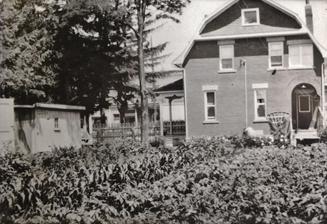
The picture of the back yard shows the garden
that William cared for so well.
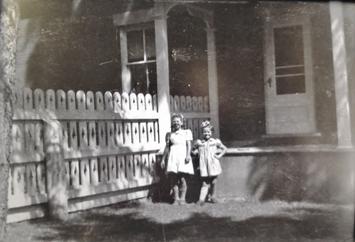
The two girls are Barbara Hotchkiss, age 10 and
Carole Hotchkiss, age 7.
This picture was also taken around 1943.
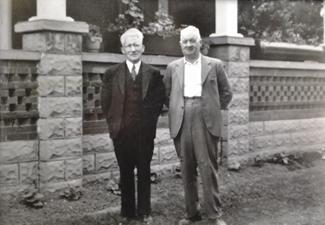
The two men are standing in front of the
verandah of William’s house.
The gentleman’s name on the left is Alec. The man
on the right is unknown.
In Volume 7, Page 275, Dec. 27, 1924 William
mentions that they named their home in Stouffville “Beth-Eden”.

This shows the house as it is today in 2013. It
is now a doctor’s office.

The verandah has been closed in.

The beautiful garden area is now a parking area
out of necessity.
D Prosser – Pastor at
Church Hill Christian Church
Volume 4, Page 392, December 28, 1901
Many times a D. Prosser is mentioned, as in this
reference, as preaching at or doing a funeral at the Church Hill Christian
Church. His first name was Daniel. He was the youngest of 10 children, son of John Prosser (John the elder). John’s
father emigrated from New York State to Ontario, Canada.
Daniel Prosser was
born in Keswick on Mar. 21, 1846. He passed away on Nov. 4, 1929. Daniel
ministered in the Newmarket area serving as an itinerant pastor much of the
time. He married so many couples that he was known as “Marrying Dan”. Daniel’s
older brother Elijah had a grandson (Elijah Prosser – Charles Franklin Prosser
– Earle Prosser) named Earl Prosser who was a pastor in Ontario in the 1950s in
the United Missionary Church denomination that some of the current Quantz
family had a connection with over the years.
AW Banfield Renting
William & Flo’s House
Volume 6, Page 148, May 14
William and Flo rented
their house to Mrs. Banfield for the summer months while they travelled to the
west coast. Mrs. Banfield was the wife of an African missionary who was returning
to the Toronto – Stouffville area on furlough. She would move in the beginning
of June when William and Flo left for their vacation. A church in northern
Toronto called Banfield Memorial Church, part of the Evangelical Missionary
Church denomination, was named after missionaries Mr. and Mrs. A. W. Banfield.
To support that this
was Mrs. AW Banfield that William and Flo were renting to see page 11,
paragraph 2 of a document entitled “Literature Outreach in Nigeria” – A History
of SIM Literature Work by Jim Mason at http://images.sim.org/pdfs/literature-outreach-in-nigeria.pdf
William’s References To The Mennonite People
Volume 7,
Page 366
Saturday
night, July 19, 1930.
Have been
trying to trim up my hoe crop which has suffered in my absence and doing a
little more painting. I spent some time watching the operations of the Warren
Company of Toronto who started breaking up Main Street preparatory to making a
new pavement. The Mennonite people
are having Evangelistic Meetings in the Arena led by Mr. Thomas, a Welshman,
accompanied by a quintette of colored people as
singers. There is a large attendance.
July 26:. Last Sunday the preaching service was taken by Van Norman
from Keswick. Gordon and Eva are up from the city and all of us went to
service. Monday evening’s service was the last of the Evangelistic Services.
Mr. and Mrs. Thomas are both preachers and Lacey, Talbot, Jones, Hodges and
Parker were the colored singers. There has been tremendous
crowds at the Arena to hear them. [JQ Note: This would be the famous
Cleveland Colored Quintet who sang in many camp meetings in Ontario.]
Volume 8,
Page 381
Saturday
night, June 13, 1931.
Volume 8,
Page 382
July 25:. The Mennonites
are having Special Services in the Arena this week and I have been attending
them. Gordon and his girlfriend have been holidaying in Muskoka. There has been some heavy rains so we are not suffering from
drought like some other places.
Volume 8,
Page 447
Saturday
night, December 1, 1934.
In part - Our meeting was
postponed on Wednesday out of courtesy to the Mennonites who are holding evangelistic services.
Volume 8,
Page 454
Saturday,
July 6, 1935.
August 3:. In part; Mennonite Camp Meeting in the Park.
Volume 8,
Page 483
Saturday
night, April 4, 1936.
When we arrived at the church last Sunday morning we found the
basement flooded and the furnace unusable, so our congregation went to the
Mennonite Sunday School and Service. Sermon by Rev. Brubaker.
[JQ Note: The Mennonite Church was only two doors west of the
Christian Church on the same north side of Main Street, Stouffville. This
Mennonite Church was the Mennonite Brethren In Christ
Church built in 1903. This Mennonite congregation later became known as the
United Missionary Church and now the Evangelical Missionary Church. This
congregation now meets on the 10th Line, north of Main Street and is
known as EastRidge Evangelical Missionary Church.
In researching this I spoke with three individuals at Markham
Missionary Church who remember attending Evangelistic Services held in the
Stouffville Arena in the years following these.
The Christian Church and the Mennonite Brethren in Christ Church seemed
to have many connections attending each other’s services and even had a joint
church in Altona called the “Altona Union Church” with the building erected in
1875. They worshiped side by side with a joint Sunday School
for 80 years. As a side note, my uncle Rev. Don Pugh was one of the last
pastors of this church.]
---
End ---